
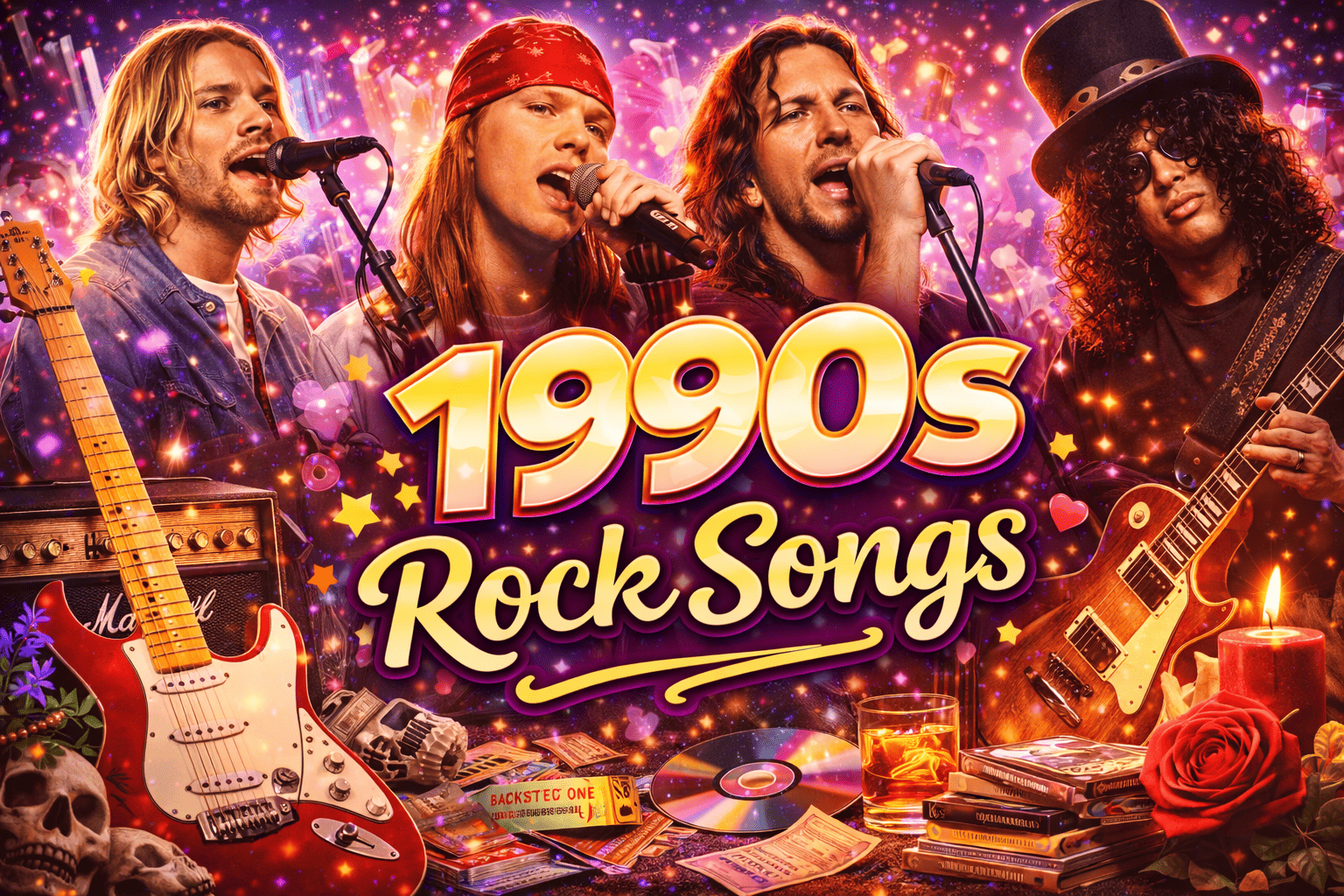
Picture this: it’s 1991, you’re thirteen years old, and you’re watching MTV when a music video comes on that looks nothing like anything you’ve seen before. No hairspray, no spandex, just a guy in a cardigan screaming into a microphone in a high school gymnasium. By the time “Smells Like Teen Spirit” ended, something had permanently changed. That is the power of ’90s rock — it did not ask for your attention. It just took it.
Three decades later, these songs are still everywhere. There is a reason for that.
The Grunge Explosion
Grunge did not just introduce a new sound — it made the previous decade’s rock feel almost embarrassing overnight. Seattle bands like Nirvana, Pearl Jam, Soundgarden, and Alice in Chains replaced glossy production and rock star posturing with something that felt genuinely unfiltered. The music was loud, the lyrics were dark, and the whole thing landed like a cold shower on a generation that had grown up on power ballads.
What made grunge stick was its emotional honesty. Songs like Pearl Jam’s “Alive” and Alice in Chains’ “Man in the Box” were not trying to be anthems — they just became them anyway, because people recognised something real in them. Nirvana’s Nevermind did not sell 30 million copies because of clever marketing. It sold because it said something true.
Alternative Rock Goes Mainstream
While grunge was grabbing headlines, alternative rock was doing something quieter and arguably more lasting. Radiohead’s OK Computer (1997) is the obvious reference point — an album so ahead of its time that critics are still finding new things to say about it. But the broader alternative scene was just as rich: R.E.M.’s introspective jangle, The Smashing Pumpkins’ orchestral ambition, Beck’s genre-hopping restlessness.
What alternative rock understood, better than almost any other movement of the decade, was that rock music could be intelligent without being cold. That combination turned out to have an extraordinarily long shelf life.
Britpop, Punk, and the Rest
The mid-’90s were genuinely chaotic in the best possible way. In the UK, Oasis and Blur were turning a musical rivalry into a national conversation. In the US, Green Day’s Dookie (1994) and The Offspring’s Smash (1994) reminded everyone that punk was not dead — it had just been waiting for the right moment to get loud again.
Metallica was selling out stadiums. Korn was inventing nu-metal. Alanis Morissette was writing the breakup album that an entire generation of women had needed for years. Foo Fighters, formed from the wreckage of Nirvana, somehow managed to sound joyful. The decade had range, and that range is exactly why it holds up so well in retrospect.
The 25 Most Iconic 1990s Rock Songs
These are not just good songs. They are the ones that defined what the decade sounded like and still sound completely alive today:
- Nirvana – “Smells Like Teen Spirit”
- Pearl Jam – “Alive”
- Radiohead – “Creep”
- Red Hot Chili Peppers – “Under the Bridge”
- Oasis – “Wonderwall”
- The Smashing Pumpkins – “1979”
- Alice in Chains – “Man in the Box”
- Soundgarden – “Black Hole Sun”
- Metallica – “Enter Sandman”
- Green Day – “Basket Case”
- R.E.M. – “Losing My Religion”
- Foo Fighters – “Everlong”
- Blur – “Song 2”
- Alanis Morissette – “You Oughta Know”
- Nine Inch Nails – “Closer”
- Beck – “Loser”
- Stone Temple Pilots – “Interstate Love Song”
- Live – “Lightning Crashes”
- Bush – “Glycerine”
- Collective Soul – “Shine”
- Korn – “Blind”
- The Offspring – “Self Esteem”
- Counting Crows – “Mr. Jones”
- Weezer – “Buddy Holly”
- Rage Against the Machine – “Killing in the Name”
Why These Songs Still Matter
Put any of these songs on at a party and watch what happens. It does not matter whether the room is full of people who lived through the ’90s or people who were not yet born — the reaction is almost always the same. Someone turns their head. Someone starts nodding. Someone knows every word.
That is not nostalgia doing the work. Nostalgia explains why a forty-year-old gets emotional hearing “Wonderwall.” It does not explain why a nineteen-year-old has it saved on their playlist right now. These songs endure because they were built on something real — real frustration, real longing, real joy — and real emotions do not have an expiry date.
The ’90s were not a golden age because everything was perfect. They were a golden age because the music was honest, and honesty, it turns out, ages better than almost anything else.